

What is the NearWin™
The NearWin™ is a neurological pattern in which the brain releases more dopamine during a near-miss than during an actual win, rewarding ‘almost’ more than completion, and reinforcing the same stalled behaviors repeatedly. Research by Chase and Clark (2010) in the Journal of Neuroscience confirmed that near-miss outcomes activate the brain’s reward centers nearly as strongly as an actual win, with the effect intensifying through repetition. For entrepreneurs, this mechanism operates beneath every delayed hire, missed revenue milestone, and launch that never ships, and it cannot be resolved through willpower or motivation alone, but through sustained behavioral practice inside a structured community container.
Every entrepreneur I’ve worked with in twenty years of executive coaching and leadership development training has a version of the same story. The round that got to a term sheet and then quietly died. The launch that slipped from Q2 to Q3 to “early next year.” The hire everyone privately knew wasn’t working, kept on for eleven months past the point of clarity. The revenue plateau that’s shown up at almost the same number three years running.
None of these people lack talent, intelligence, or work ethic. What they have in common is a pattern I call the NearWin™, and understanding it changes how you diagnose almost every procrastination, every revenue ceiling and every stall point in a growing or established business seeking more growth.
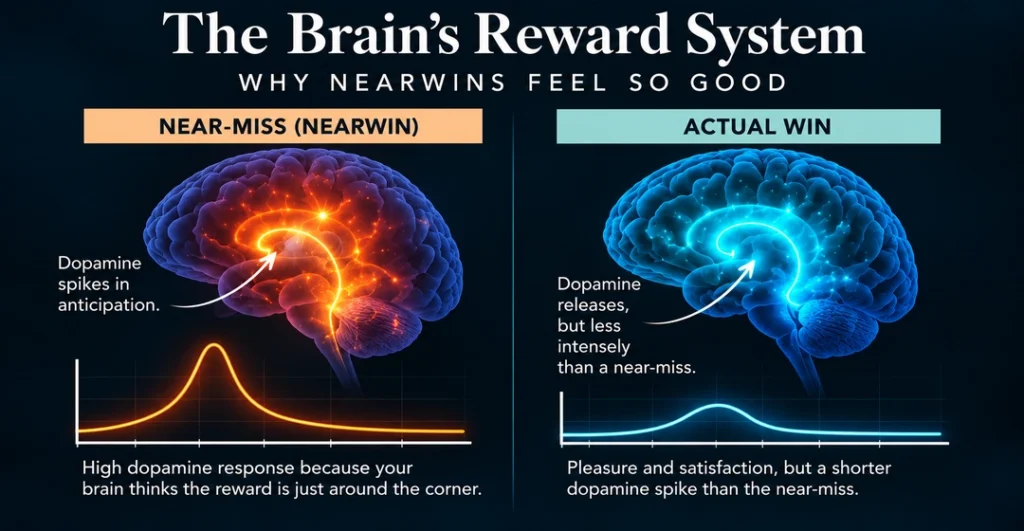
The Mechanism: Your Brain Neurochemically Rewards Almost More Than Success
Here is the finding that reframed how I think about entrepreneurial stagnation: the brain releases more dopamine during a near-miss than during an actual win. Neuroimaging research by Chase and Clark (2010), published in the Journal of Neuroscience, showed that near-miss outcomes activate the brain’s reward centers – the ventral striatum and anterior insula – nearly as strongly as an actual win does, and the effect is strongest in people whose engagement with a behavior is most compulsive. Follow-up work by Winstanley, Cocker, and Rogers (2011) traced this to dopamine receptor pathways that shape reward expectancy, explaining why “almost” keeps the brain motivated to continue doing the same things, the same actions, the same habits over and over again, rather than signaling that it’s time to stop and do something different; A.K.A change! Habib and colleagues (2016) found that this near-miss sensitivity intensifies with repetition: the more entrenched the pattern, the stronger the neural response and reward system creating the “addiction” to almost.
This is a mechanism running quietly underneath every “not yet”, “not ready”, “not the right time”, “I don’t want to spend the money”, “I need to give what I’m doing more time” in your business.
Dr. Ryan Williamson, a board-certified neurologist and founder of Transcend Health, reviewed the NearWin framework directly and put it this way in his professional assessment: the framework is consistent with established research on dopaminergic reinforcement, habit formation, reward prediction, and behavioral persistence; and behaviors that begin as consciously chosen goals can, through repetition, become automatic and resistant to change, a shift tied to dopamine-dependent learning first described by Balleine and Killcross (2007). Once that pattern is encoded, it persists even when you consciously want something different. That’s not a willpower gap, it’s your brain’s architecture.

Why This Hits Entrepreneurs Specifically
Entrepreneurship is uniquely fertile ground for the NearWin, because almost every meaningful milestone in building a company looks like progress long before it produces a result. Pitching investors feels like fundraising. Interviewing candidates feels like building the team. Reading another book on scaling feels like scaling. Each of these delivers a small dopamine hit, the brain’s signal that you’re “doing it” without requiring the discomfort of the actual, harder action: closing the round, making the hire, firing the wrong one, shipping the thing.
I think often about a study cited in Alan Deutschman’s Change or Die: researchers followed heart attack patients who had been told directly by their own doctors that without substantive lifestyle change, they would likely have another heart attack; one that could kill them. Less than 10 percent made any substantive lasting change at all. If people won’t change to save their life, forget about making the necessary changes to handle a bad hire, a stalled product, or a co-founder relationship that’s run its course. The wiring working against the heart attack patients is the same wiring working against your ability to make the changes in your business that would lead to your success.
It also explains the paradox of the roughly $50 billion spent globally each year on self-improvement / self-help / personal development / personal growth / human potential courses, and coaching. The act of signing up for the program delivers its own near-win “hit”, you’re doing something about it – you’re taking action and that feeling so powerfully substitutes for the actual essential behavior change that the old pattern simply resumes, dressed as momentum. Compounding this, the forgetting curve documented by Hermann Ebbinghaus in 1885 shows that roughly 75 percent of new information is lost within 48 hours without reinforcement to pre-existing knowledge. Access to information was never the bottleneck. You already know what you need to do, but that doesn’t stop people from spending even more money on information not tied to practical transformational action. Knowing it again in a new format doesn’t change the neurochemistry keeping you at “almost.” In fact, it just reinforces the cycle!
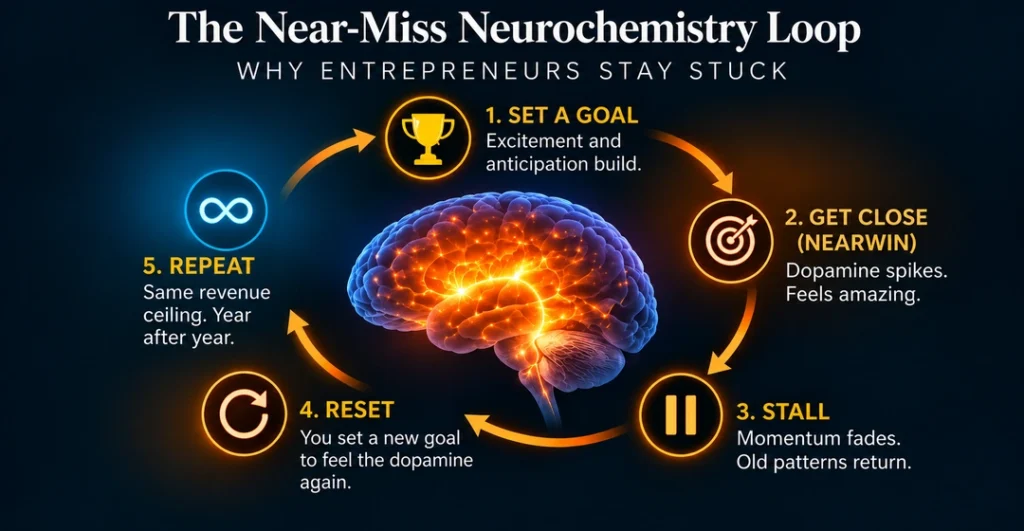
Why Willpower Alone Can’t Fix It, And What Does
If the NearWin operates below conscious control, no amount of grit, morning routines, or motivational content will out-negotiate it operating alone. The research on habit formation is clear that once a behavior pattern is dopamine-reinforced, it persists specifically because it no longer depends on your conscious intention. You cannot out-willpower a mechanism that isn’t asking your willpower’s permission.
What interrupts it is a structure bigger than the individual: a container that catches the moment the old pattern tries to reassert itself, before it does. This is precisely why our reProgram Whole Life Architecture exists.
Whole Life Architecture is a 12-month group program built specifically to interrupt the NearWin cycle at its root — not through more information, not through mere motivation and inspiration, but through sustained weekly practice inside a community container of other entrepreneurs and business owners who are doing the same work on their NearWin cycle as you are, in real time. Where a book or a course gives you the near-win hit of feeling like you’ve started, Whole Life Architecture is designed around what the neuroscience actually requires for lasting change: repeated practice, accountability that doesn’t rely on your own discipline alone, and a community that notices the pattern in you before you notice it in yourself, and encourages you to make the necessary changes to finally succeed and thrive.
Inside the program, you don’t just learn the NearWin framework intellectually, you apply it to the specific incompletions running your business and your life right now: the hire you haven’t made, the sales and revenue number you haven’t hit, the conversation you’ve been almost having for months with that new potential client, or investor, business partner. You identify them, you complete them, and you build the new behavior in community, because new behavior, unlike inspiration and motivation alone, has never once taken root in isolation.
The goal isn’t a business that looks fine from the outside, while you privately know it’s stalled at almost. It’s a business, and a life, built by design instead of one tolerated by default.
If you’ve read this far and recognized your own pattern in it, that recognition is the first real step. The next step is you not becoming trapped in the NearWin from taking the action to enrol in Whole Life Architecture.
You’re in luck. Whole Life Architecture is about to begin a new cohort in January 2027, with our 2-month introductory program available in November of 2026. Don’t just think about – act. If you choose, this is the beginning of the defeat of your NearWin cycle.
Learn more about Whole Life Architecture and whether it’s the right fit for where your you and your business is stalled.
I’ll see you in the workshop!
Chad Lefevre
Co-Founder, The Most Important Conversations
Creator, The Near Win