
Discernment Is the Anchor of Liberated Living because it turns spontaneity into alignment instead of chaos. Liberation isn’t the absence of structure. It’s the presence of something deeper: discernment.
As we’ve journeyed this week through the layered terrain of spontaneity, reactivity, and self-trust, today’s meditation introduces a new dimension: discernment as the force that keeps spontaneity aligned with you as a BEing (distinct from the human DOings we were conditioned as).
Because spontaneity, if untethered from presence and intention, can drift.
And if you want to be spontaneous, present and powerful… free and in integrity…
You need discernment. Not judgment. Not control. Not even boundaries!
But the cultivated art of knowing what aligns with you and what doesn’t.
Why Spontaneity Needs Discernment
At first glance, spontaneity might seem like the enemy of structure.
But that’s only true if your idea of structure is rigid, external, and dictated by external “shoulds.”
The kind of structure that supports liberated living is inner being-based structure, and that’s where discernment lives.
Discernment is the invisible scaffolding that allows you to respond spontaneously, moment-by-moment without losing yourself. It’s the thread that ties each spontaneous choice back to your values, your truth, and your deeper intention.
Without it, spontaneity becomes chaos.
With it, spontaneity becomes creation.

Judgment vs. Discernment: Know the Difference
Judgment divides the world into good and bad, right and wrong. It’s external, comparative, overly simplistic and fear-based.
Discernment is different. It’s internal and connected to purpose.
Judgment says:
- “This is wrong.”
- “They shouldn’t do that.”
- “I messed up.”
Discernment says:
- “This isn’t aligned with who I am.”
- “This doesn’t feel true for me at this moment.”
- “That option might be fine for someone else—but doesn’t align with me and what I’m creating.”
Discernment doesn’t shut doors with finality, it clarifies your path in real time, allowing for nuance and flexibility. And when paired with spontaneity, it lets you dance with life, while staying centered in who you are.
The Danger of Getting Swept Up
Here’s where it gets tricky.
Spontaneity is alive. It’s playful. It’s responsive. It’s dynamic and changing. But without discernment, it can easily become performative or reckless. You can get caught up in a moment, in a person’s energy, in group dynamics and start acting in ways that look “loose and natural” but aren’t actually your authentic loose and naturalness.
You may leave the moment feeling off. Overexposed. Disconnected from your center.
Why?
Because you weren’t responding from intention, alignment, and presence, you were reacting to the situation.
This is why discernment is vital.
It allows you to ask:
“Is this authentic for me, or am I swept up in the energy around me?”
“Am I staying true to my intention, or am I slipping into expectation?”
“Does this have integrity for me, or is it simply validation seeking?”
This moment of inquiry makes the difference between spontaneous alignment and self-abandonment.
Predictability Is a Tempting Escape
When we don’t trust our ability to discern, spontaneity becomes impossible. We plan everything, grasping for control.
Planning becomes our way of managing the discomfort of uncertainty.
We map out our words, our outfits, our timelines. We script our lives until nothing can surprise us.
But there’s a cost.
The more we plan, the less we practice presence.
The more we rely on external structure, the less we refine our inner guidance.
The more we cling to “what should be,” the more we lose touch with “what is.”
That’s not discernment, that’s control, and control is always rooted in fear.
The invitation here is to drop planning, and to begin learning to feel, listen, and respond. And that requires discernment. Have a reference, but drop planning and goal setting, because planning and goal setting is a modern way of saying being attached to a future state. When this happens we begin to bend our integrity and become divorced from what aligns with our intention and ourselves as a BEing.
Discernment Is a Practice, Not a Trait
Discernment isn’t a fixed personality trait. It’s a muscle. A skill. And like any skill, it grows through practice and reflection.
Today’s meditation was designed to strengthen that skill.
Before diving into the practice, I posed a series of questions:
- How do you know what is aligned in the moment?
- What signs or sensations guide your spontaneity?
- Where might you be defaulting to cultural norms instead of your inner knowing?
These aren’t abstract inquiries. They are navigational tools – questions to help you begin to feel the difference. They are the inner dials you must learn to read if you want to create your life from a place of liberation instead of conditioned societal programming.

Meditation Practice: Stepping Into the Field of Possibility
Mignon then led us through a neural sculpting meditation, this time oriented toward visualizing and embodying the unknown.
But instead of simply imagining a future, she invited us to feel our way into it. To explore what it looks, sounds, and tastes like to create a space of possibility rooted in our own truth.
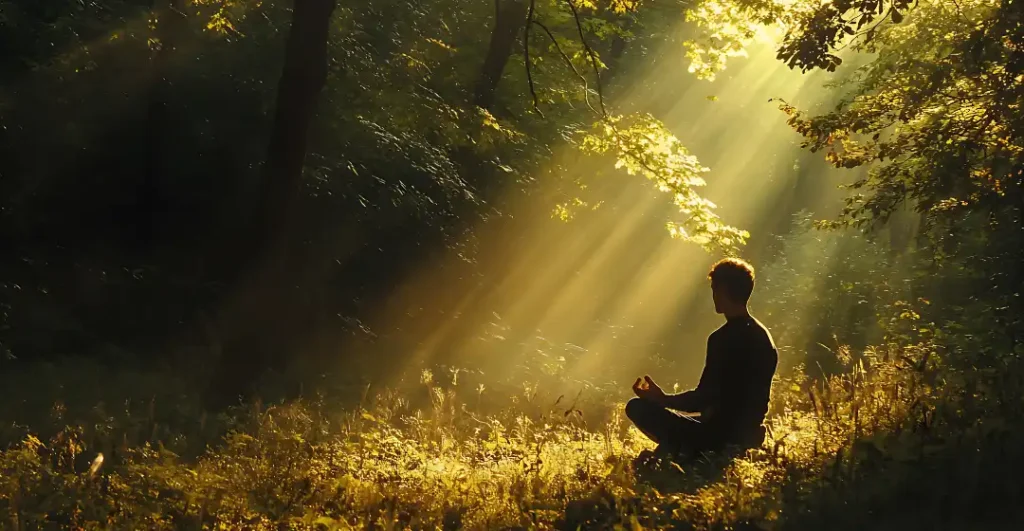
We began by orienting to that space; feeling the body supported by the earth, noticing the breath, softening the tension. Then, gently, we were invited to bring to mind an area of life filled with uncertainty. A dream, a decision, or a problem still waiting for clarity.
From there, the imagination was awakened:
- What would it feel like to succeed here?
- What colors, textures, or sounds accompany your future vision?
- What physical sensations arise when you anchor this visualization in your body?
Participants were encouraged to place the visualization into their body, to locate where it wanted to live. In the hands? The heart? The belly?
Then came the activation:
- Choose a word that connects you to this truth.
- Make a hand gesture that anchors the feeling.
This anchoring is how discernment becomes embodied. You begin to know what’s true, not just in theory, but in sensation.
Discernment Is the Art of Noticing
Discernment isn’t just about what you do, it’s about how you feel when you do it, and that requires your BEing to lead your DOing.
When you act from discernment, your body usually feels:
- Calm, but alert
- Clear, but open
- Grounded, even in motion
When you’re out of alignment, your body might feel:
- Rushed
- Tight
- Overextended
- Numb or scattered
The more you track these signals, the more your discernment sharpens. You start to recognize the felt sense of alignment before the mind can rationalize it.
And that gives you choice.

Discernment vs. Drifting: The Subtle Edge
We closed the teaching with a powerful distinction:
When you live spontaneously without discernment, you drift.
When you live spontaneously with discernment, you create.
Drifting looks like:
- Saying yes out of politeness, looking good, validation
- Abandoning your boundaries to match group energy
- Taking action to avoid the discomfort of not fitting in
Discernment looks like:
- Choosing what’s aligned, even if it’s unpopular
- Feeling your way through real-time decisions
- Being in flow without losing your integrity
You can be flexible and clear. Soft and sovereign. Spontaneous and deeply rooted in who you are.
That’s the mastery we’re building here.
Weekend Reflection: Practicing the “Martial Art of Awareness”
I left the group with this image:
A martial artist, standing poised, still, fully in his body. He does not move preemptively. He does not anticipate based on the past. He waits. Calm, attuned, and ready to respond from total presence.
This is what liberated, spontaneous living looks like.
You don’t flail. You don’t plan every strike.
You discern in the moment
You move when it’s time and you move from your inner knowing.
This is the cognitive and emotional equivalent of mastery. And it’s available to all of us, every day, with practice.

Integration Invitation
As you move into your day, here’s your practice:
- Pause often.
Notice when you’re drifting or defaulting to external expectation. - Ask gently:
Does this feel like me? Or does this feel like the moment sweeping me up? - Make micro-choices that reflect your clarity.
One aligned choice at a time is how a sovereign life is built. - Revisit your word and gesture.
These are anchors. Use them to reconnect when you feel yourself drifting. - Celebrate your awareness.
Discernment takes time. It deepens with every moment you choose to listen instead of react.
Join Us for Daily Meditation
This meditation was part of our weekday series, held every Monday through Friday from 10am–11am EST.
Together, we practice:
- Spontaneous action from alignment
- Watcher/observer consciousness
- Neural sculpting to reshape internal narratives
- Cultivating presence, power, and peace
If you’re ready to deepen your discernment and lead from a liberated presence, join us via The TMIC Free Community.
Breathe. Watch. Choose. And begin to feel what it’s like to trust your alignment in real time.
Because the more refined your discernment becomes, the more spontaneous and liberated you will become.