

When companies struggle with collaboration, accountability, or alignment, the default diagnosis is: “We have a culture problem.” That sounds simple, but it misses the mark. Culture is not an isolated issue, it’s the visible expression of the invisible patterns running underneath the business.
What people call culture (how decisions get made, how conflict is handled, how fast work moves through the system) is not created by motivational posters or all-hands speeches. It’s created by the design of the organization itself: the structures, incentives, communication flows, and leadership norms that quietly shape behavior every single day.
So when you see a culture that feels toxic, sluggish, or resistant, what you’re really seeing is a pattern problem that has been left unchecked. True culture change doesn’t happen by asking people to “act differently.” It happens when leaders redesign the patterns that drive how the system actually works.
This is why culture change efforts so often fail: they target behavior at the surface while leaving the deeper patterns untouched. When you change the pattern (how work is structured, how authority and accountability are aligned, how information moves) culture shifts as a natural outcome.
Leaders who try to “fix culture” without addressing these deeper patterns end up chasing symptoms. Leaders who have the courage to look under the surface create organizations where collaboration, alignment, and accountability are not aspirational, they’re inevitable.
What We Get Wrong About Culture
Culture isn’t your vibe. It’s not your values poster, your perks, or how “nice” your team is on Slack.
And it’s definitely not a mystery that only HR can solve.
Most leaders treat culture like it’s a personality trait; something you either “have” or “don’t.”
So when engagement drops, silos grow, or collaboration flatlines, the instinct is to launch mindset training, pump up motivation, or add a few more check-ins.
But, culture is not the cause. It’s the output.
It’s the exhaust that gets produced from your team’s daily operating patterns; how decisions get made, how power flows, how tension is handled, how time is valued, and how voices are heard.
Let’s make that real:
- If speed is rewarded over substance, you get burnout and brittle decisions.
- If meetings lack clarity, you get politeness on the surface and chaos underneath.
- If only leaders own accountability, everyone else waits for permission or blames up the chain.
- If conflict is avoided, innovation gets stifled, and people hide behind agreement.
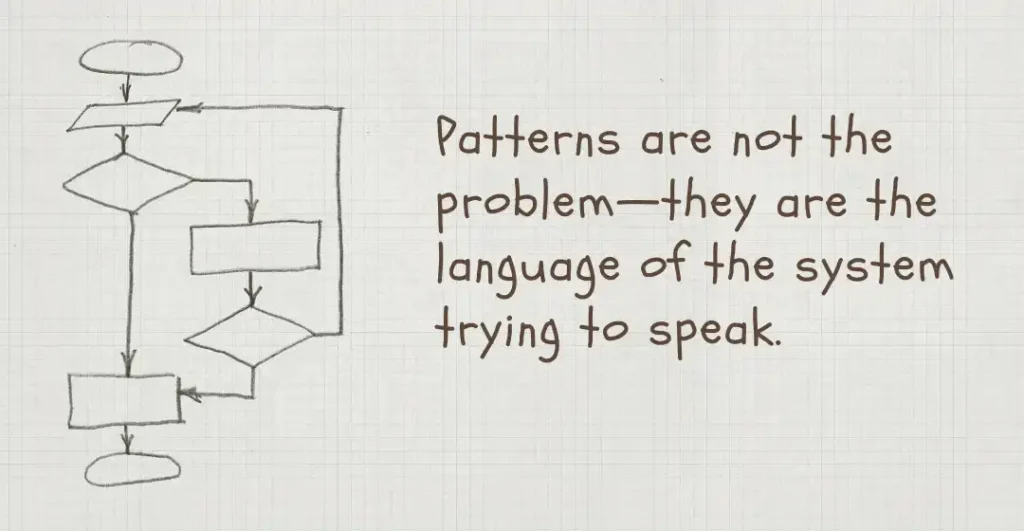
Those aren’t culture problems. They’re system problems; pattern problems.
And here’s where it gets more dangerous:
When these patterns repeat long enough, they calcify.
They become the unspoken code, the invisible operating system, that drives behavior, no matter what the values on your website say.
So even the best-intentioned leaders end up frustrated.
Because they’re trying to shift how the organization feels without changing how it functions.
They’re pruning the branches when the issue is in the root system.
If you want a new culture, you don’t start with a motivational speech.
You start with a redesign of the rhythms, rituals, and rules that shape how your team actually operates.
Change the pattern.
The culture will follow.
What Patterns Are (and Why They Matter)
Patterns are the repeatable ways your organization thinks, decides, communicates, and executes.
They show up in:
- How meetings are structured (or not)
- How decisions get made (or avoided)
- How conflict is addressed (or buried)
- How priorities shift (or stay stuck)
- How feedback is given (or withheld)
- How wins and failures are recognized (or ignored)
Patterns operate like the grooves on a record; they guide the behavior of the needle (your team) even if no one’s consciously steering. They’re often legacy decisions, inherited behaviors, or default processes that were never revisited.
Because of their subtlety, these patterns can be incredibly difficult to detect from inside the system. But they directly impact how people feel at work, how they show up, and what results they produce.
The Problem with Fixing Culture in Isolation
Trying to change culture without shifting the underlying patterns is like painting over rust. It looks good for a while, but the root problem is still active.
Culture initiatives that focus only on values, workshops, or surface-level engagement don’t stick. Why? Because the day-to-day experience of work hasn’t changed.
If people are still trapped in reactive cycles, silos, and unclear expectations, no amount of motivational messaging will change behavior.
Here’s what happens:
- Leaders launch values campaigns, but employees still don’t know who owns what.
- Teams attend collaboration trainings, but silos remain intact because structures weren’t addressed.
- Surveys point to engagement issues, but workload, communication, and decision-making remain chaotic.
Culture gets blamed, but structure is what’s broken.
Changing the Pattern That Drives the Culture
This is where the DesignSummit comes in.
DesignSummit isn’t a lecture series or a one-off team-building retreat. It’s a strategic environment where organizations:
- Visualize how they actually operate today
- Name the real friction points and breakdowns
- Repattern how decisions, collaboration, and execution happen across teams
It’s not about telling people to change. It’s about designing a new environment where new behaviors become natural outcomes.
In a DesignSummit, you don’t debate culture, you experience a new way of working. And in that experience, real decisions get made:
- Who needs to be involved?
- What feedback loops are missing?
- How do we structure ownership and accountability?
- Where are we reinforcing the wrong behaviors?
The result is a systems-level shift that makes cultural transformation possible, not through enforcement, but through design.
Real-World Examples of Pattern Problems
Here are just a few pattern-level breakdowns I’ve seen that regularly get mislabeled as “culture problems”
“People don’t speak up.”
The assumption: We need more psychological safety.
The pattern: Meetings are structurally hierarchical. Senior voices speak first (and most). There’s no intentional mechanism for surfacing diverse perspectives or dissent.
When the environment doesn’t make contribution easy, safe, and expected, silence is not a mindset issue. It’s a design flaw.
Shifting the pattern means redesigning the architecture of participation: think round-robin inputs, structured turn-taking, asynchronous idea submissions, or rotating facilitators to decentralize authority. When space is made for every voice, participation is no longer optional, it becomes embedded.
“No one takes ownership.”
The assumption: We need to build a culture of accountability.
The pattern: Roles are fuzzy. Responsibilities blur across silos. Decision-making rights are either unclear or hoarded.
In that ambiguity, ownership dies, not because people lack initiative, but because the system invites hesitation.
DesignSummit creates clarity by mapping roles, defining decision thresholds, and establishing transparent accountability structures. It doesn’t just call people to “step up”, it makes it obvious where and how they can.
“There’s no innovation.”
The assumption: We need more creativity and bold thinking.
The pattern: Risk is subtly punished. Mistakes are remembered longer than breakthroughs. The system lacks any real scaffolding for experimentation, no short feedback loops, no rapid prototyping, no real-time iteration spaces.
The result? People play it safe, even when they have bold ideas.
Solving this means operationalizing innovation building in cadences that reward risk, rituals that normalize feedback, and environments where testing new ideas is expected, not exceptional.
These aren’t personality issues. They’re pattern issues.
And once you learn to see the system, you can rewire it.
Because the truth is: people don’t resist change.
They resist confusing, high-friction, unconscious systems that keep delivering the same results no matter how hard they try.
Pattern work makes those systems visible—and redesign makes new outcomes possible.
Want a version that ties this back into a specific offer or landing page flow?
The Shift That Makes Culture Work
When you shift the pattern, the culture follows.
People don’t resist clarity, they resist chaos. They don’t resist ownership, they resist confusion. They don’t resist collaboration, they resist inefficiency.
Leaders who invest in pattern-level change are playing the long game. They’re not just trying to inspire their teams, they’re equipping them with a way to work that aligns with who they are and what they’re trying to achieve.
In DesignSummit, we don’t talk about the new culture you want, we create the conditions for it to show up in real time.
Culture isn’t a mystery. It’s a reflection.
Every team, every organization, every company (what it feels like to work there) is mirroring back the structure it’s operating within.
If your team feels reactive, it is because your systems likely reward urgency over intentionality.
If it feels overextended, it is because the load isn’t distributed based on capacity, but on habit or hierarchy.
If people seem disengaged, they might be, but far more often they’re simply burned out from working inside patterns that consistently block progress, mute initiative, and drain momentum.
We tend to pathologize people calling them unmotivated, underperforming, misaligned when in reality, it’s the architecture of the organization that’s producing the drag.
Culture is constantly sending signals.
It’s telling you where friction lives.
It’s revealing which patterns no longer serve.
It’s showing you day after day, how your design choices are shaping behavior, energy, and results.
The real question is:
Are you listening?
And deeper still, are you willing to change the structures that shape what your culture reflects?
Because until the system shifts, the mirror doesn’t lie.
It just keeps showing you what you’ve built.
Let’s Talk
If you’re facing complexity, misalignment, or a moment of reinvention, a DesignSummit may be exactly what your organization needs. Custom packages start at $50K and scale based on scope and outcomes.
Reach out to explore whether this methodology is right for you, and let’s design a process tailored to your goals.